
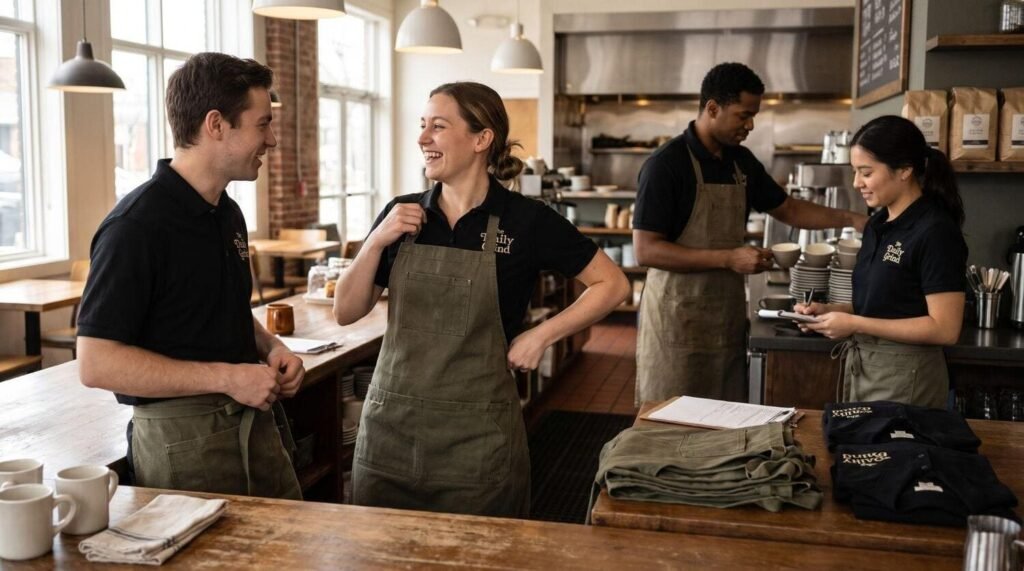
For a restaurant, it can take weeks to get the logo ready and decorated on team uniforms, signs, and on every cup. And not always from the same decorator. Any day when the service starts, the line might wear whatever black polo was clean that morning (of course with the logo on it). The servers could be doing the same, tying on aprons from a different supplier.
Something like this can be fixed by how you buy items that carry the logo of your restaurant or coffee shop.
Buy aprons wholesale in one color, and the rest of your restaurant uniforms, from polos to café merch, can be built around them without tripping a health rule or blowing the budget.
Why are restaurant uniforms part of your brand identity?
Restaurant uniforms are the part of your brand guests see from two feet away, and most guests expect them.
When TRSA, the U.S. textile services trade group, surveyed 1,000 American consumers in fall 2021, 84% said they prefer restaurant staff in uniform. In the same research, 81% of diners said it matters a great deal that wait staff look and act professional.
Looking dated hurts more than looking plain. In a 2,000-adult UK poll, “looks cheap or dated” was the top uniform turn-off (21.4%), while a designer label mattered to just 2.3%.
If the identity is still in progress, think about how marks hold up at small sizes. A stitched pocket logo is about as small as a mark gets.
Which restaurant aprons should each role wear?
Choose restaurant aprons by job. For example, heavy canvas for the line, denim or poly-cotton twill for baristas and servers, and waterproof vinyl at the dish station.
Back of house
Line cooks and pizza-oven crews get the most from a canvas bib apron, which resists spills and dirt. Waxed canvas adds water resistance, but waxed and coated aprons usually need special care, so they can’t share the regular wash. On long shifts, crossback straps move the weight from the neck to the shoulders.
Front of house and baristas
Restaurant server aprons are usually waist styles. A 15-inch shorty keeps bartenders and baristas moving freely; a 17-inch standard covers more of the leg. Upscale rooms look cleaner with one pocket, while a busy floor needs several, sized for an order pad and a wine key.
Denim is among the most comfortable apron fabrics, but its color fades fastest. Replace it as a set, or the counter drifts into three shades of blue.
Here’s how the common apron fabrics compare by role.
| Fabric | What it does well | Trade-off | Best fit |
| Canvas / waxed canvas | Heavy-duty; resists spills and dirt; wax adds water resistance | Waxed versions need special care, not a regular wash | Line cooks, butchers, pizza ovens |
| Denim | Comfortable over a full shift | Color fades fastest | Baristas, hosts, prep cooks |
| Poly-cotton twill | Dries fast, resists wrinkles, shrinks less | Plainer look than denim or canvas | Servers, high-volume rooms |
| Linen | Light and breathable | Less protection than canvas or denim | Bakers, pastry, warm open kitchens |
| Vinyl (PVC) | Waterproof | Doesn’t breathe | Dish stations |
Pick fabric by role, then hold the color steady so a navy canvas bib and a navy twill waist apron read as one restaurant.
How do you put your logo on aprons and uniforms?
Embroider the logo on aprons and polos for the most durable result, and save screen printing for tees and large back prints.
Before you order custom aprons with logo embroidery, get a one- or two-color version of the mark from your decorator. Hairline strokes and tiny taglines that look sharp on a menu fill in once stitched, and thread needs strong contrast with the fabric.
Stitch it on the upper chest of a bib, the front corner or pocket of a waist apron, and the left chest of a shirt. On waxed canvas or leather-trimmed aprons, a woven patch usually looks cleaner.
Ask the decorator for a sew-out sample before the full run, because a few days’ wait beats unboxing an order where the logo reads as a smudge from across the counter.
Which uniform polo shirts match the apron?
Embroidered polos are your front-of-house logo piece, because a waist apron covers nothing above the belt and hosts and servers face guests all night. Pick one style per role.
Fabric should follow the job. Servers brushing past chair backs need snag-protection piqué, which something like the Team 365 TT21 or the Harriton M208 both use. The M208 adds soil protection for spills. If staff wash their own shirts (90% of uniform wearers in TRSA’s research do), a 65/35 poly-cotton blend like the JERZEES 537MR resists wrinkles and shrinks very little. The 100% ring-spun cotton Gildan 64800 is more popular across this sector in the wholesale market. It feels softer and is more budget-friendly than most team styles, but its care label specifically recommends non-chlorine bleach.
Patio crews can go lighter in polyester interlock like the Team 365 TT51, and the CORE365 88181P adds a chest pocket for pens. Women’s cuts exist for several of these wholesale styles. Make sure to order uniform polo shirts in the apron’s color family and embroider both from one logo file.
What do health rules say about aprons?
The FDA Food Code requires food employees to wear clean outer clothing (§ 2-304.11), and FDA guidance says aprons belong only in food production and serving areas.
So no aprons in the restroom or on a trash run. Inspectors make staff change a soiled apron before handling food; Florida inspection reports include a bakery worker told to change after wiping his face on his apron.
Caps count, too. Food Code § 2-402.11 asks food employees to wear hair restraints such as hats, with exemptions for hosts, wait staff and drinks-only counter staff when risk is minimal. On the line, a logo cap covers the rule and the brand.
Buy enough aprons that everyone starts each shift clean with a spare on the hook, in dark colors for high-mess roles. States and counties adopt the Food Code differently, so check with your local health department.
Who pays for restaurant uniforms?
Under federal law, a required uniform is the employer’s business expense, and charging staff for it can’t push their pay below minimum wage or cut into overtime. That’s the U.S. Department of Labor’s position. Employers may spread deductions over several paydays, as long as each workweek still clears the minimum. Some states set stricter rules, so check yours before writing a policy.
How can a café turn its uniform into coffee shop merch?
Sell what your staff already wears: the same apron, cap, tote or tee with your logo turns regulars into walking signage. Coffee shops have a head start here. In that UK poll, coffee chains took the top three spots for best uniforms.
Start with a few items in a small run, and reorder what sells. Reuse the embroidery file from your uniforms so the design is already digitized and sample-tested before the first tote is stitched. You can also just have a separate merch line.
The bottom line on buying aprons wholesale
One logo file, one color palette, one apron per role. Buy aprons wholesale so every station matches, embroider polos for the people guests talk to, and let your merch reuse the stitching you’ve already approved.
FAQs
What should restaurant staff wear?
An apron and a polo or tee in your brand color covers most dining rooms and cafés, with dark pants and slip-resistant shoes. Back-of-house staff usually wear bib aprons for coverage. Servers and baristas wear waist aprons with pockets. Keep it to one shirt style per role, so outfitting a new hire is a single line on the size sheet.
What is the best fabric for restaurant aprons?
On a hot line with grease and open flame, canvas is the most durable choice, and waxed canvas adds water resistance at the cost of special care. Baristas and hosts usually prefer denim for comfort. Servers in high-volume rooms do well in poly-cotton twill because it dries fast and resists wrinkles. Dishwashers need vinyl, since it’s the only one of these fabrics that’s waterproof.
Is embroidery or printing better for a logo on aprons?
Embroidery is the usual pick for aprons because the stitches hold up to frequent washing and look more finished up close. Screen printing suits large designs, like a back print on a tee. On waxed canvas, a woven patch is often easier than stitching straight through the coating. Whichever method you choose, approve a sample before the full order.
How often should restaurant aprons be changed?
Once per shift is the floor, plus any time an apron gets soiled. The FDA Food Code requires clean outer clothing, and inspectors make staff change a dirty apron before handling food. Keep a spare on the hook for every cook. When washing, separate waxed or coated aprons, which usually need special care, from canvas, denim and twill, many of which can be machine-washed.
Can restaurant workers wear aprons outside the kitchen?
Outside the kitchen and dining room, the apron comes off. FDA guidance says aprons should be worn only in food production and serving areas, not in restrooms, on breaks or while taking out garbage. Local health departments enforce their own version of these rules, so post the policy where staff hang their aprons and check what your county inspector expects.
Do restaurants have to pay for employee uniforms?
Federal law treats a required uniform as the employer’s business expense under the Fair Labor Standards Act. If staff pay for it, the cost can’t reduce their pay below minimum wage or cut into overtime, though employers may spread deductions over several paydays. Several states have stricter rules, so check your state labor department before setting a policy.
How long should a server apron be?
Fifteen inches is the common short length, and 17 inches is a standard waist apron. Shorter aprons give bartenders and baristas more freedom to move behind a tight counter. Longer ones protect more of the legs. A bib apron is a different garment, covering the chest too, and it’s the better pick for anyone working the line.
Where can I buy restaurant aprons wholesale?
Look for a supplier that decorates as well as sells blanks, so you can order aprons wholesale, add the logo and match polos in a single order. Before you buy, ask for a stitched sample. Also check that the same style and color will still be available when you reorder, since one discontinued shade can break a matched set across the whole staff.
What merch should a coffee shop sell?
Start with items that use the same logo file as your uniforms, like a tote, a cap, a tee or the staff apron itself. Small runs limit the risk. Reorder the pieces that sell and drop the ones that sit. Shelving merch by the register or pickup counter puts it in front of regulars on every visit, while they wait for their order.