
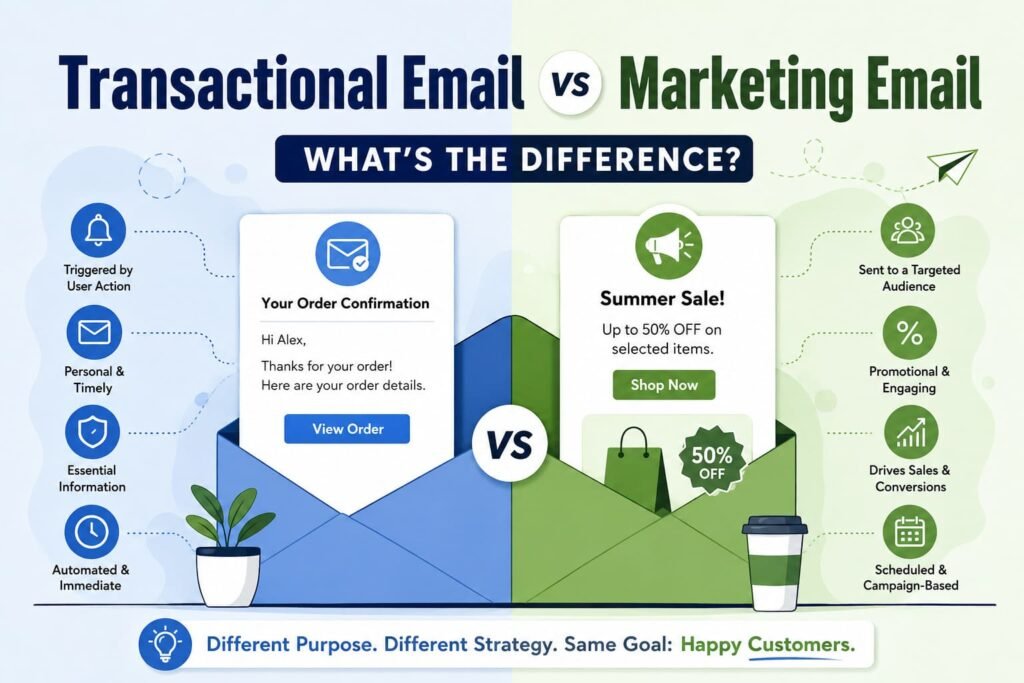
Your customer just created an account. Should you send a welcome email? Absolutely. Should you use that same email to blast them with five product promotions? Probably not.
That little distinction explains the difference between transactional email vs marketing email. Both types help businesses communicate with customers, but they serve very different purposes.
I’ve found that once you understand the difference, email strategy gets much easier. So, let’s break it down without turning this into a textbook nobody asked for.
What Is a Transactional Email?
A transactional email responds to a specific action or event involving a customer.
Think about what happens after you create an account on a website. You might receive an email asking you to verify your address. When you place an order, you get a receipt. Forget your password? Yep, another email arrives.
These messages usually provide information that the recipient expects or needs.
Common transactional emails include:
- Account verification emails
- Password reset emails
- Order confirmations
- Invoices and receipts
- Shipping notifications
- Subscription confirmations
- Security alerts
- Welcome emails triggered by registration
- Account or service updates
The key idea here is simple: a user action triggers the email.
For example, if I buy a pair of headphones online, the store doesn’t need to guess whether I want an order confirmation. My purchase triggers it automatically.
That makes transactional email an important part of the customer experience.
What Is a Marketing Email?
Marketing emails have a different job. Instead of responding to a specific customer action, they aim to promote, educate, engage, or re-engage an audience.
You probably see these emails all the time.
A clothing brand might announce a weekend sale. A software company might promote a new feature. A newsletter might share its latest articles.
Marketing emails often include:
- Promotional offers
- Product announcements
- Newsletters
- Seasonal campaigns
- Special discounts
- Product recommendations
- Educational content
- Re-engagement campaigns
- Event invitations
Unlike transactional messages, marketing emails generally target a broader audience.
And yes, marketers love the phrase “limited-time offer.” Sometimes the offer really is limited. Sometimes it mysteriously returns three weeks later. Funny how that works.
Transactional Email vs Marketing Email: The Key Differences

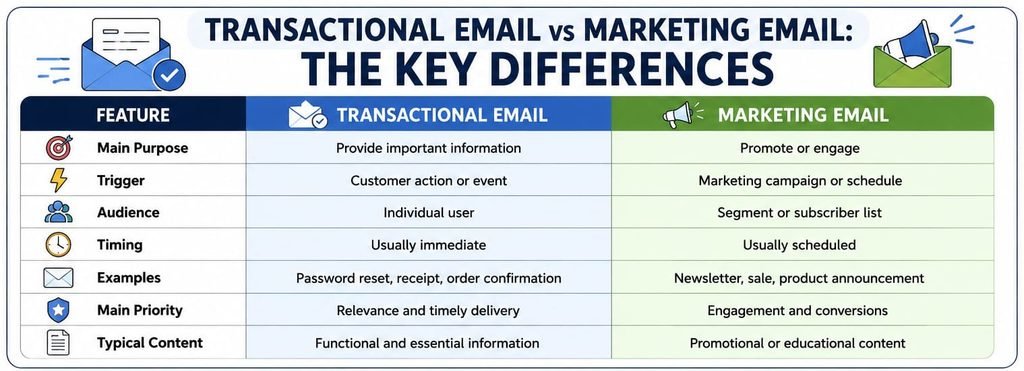
So, what separates these two email types?
The easiest way to understand the difference involves looking at purpose, triggers, content, and audience.
| Feature | Transactional Email | Marketing Email |
|---|---|---|
| Main purpose | Provide important information | Promote or engage |
| Trigger | Customer action or event | Marketing campaign or schedule |
| Audience | Individual user | Segment or subscriber list |
| Timing | Usually immediate | Usually scheduled |
| Examples | Password reset, receipt | Newsletter, sale |
| Main priority | Relevance and timely delivery | Engagement and conversions |
| Typical content | Functional information | Promotional or educational content |
The biggest difference comes down to why you send the message.
A transactional email helps someone complete or understand an action. A marketing email tries to influence what someone does next.
Why Transactional Email Needs Reliable Delivery
Imagine requesting a password reset and waiting 30 minutes for the email.
Not ideal, right?
Transactional messages often contain information that customers need immediately. A delayed verification email can prevent someone from creating an account, while a delayed payment confirmation can leave a customer wondering whether the transaction actually worked.
That’s why transactional email deliverability matters so much.
A good transactional email setup should help you:
- Deliver messages quickly
- Maintain sender reputation
- Authenticate your sending domain
- Monitor bounces and other delivery events
- Handle large sending volumes
- Integrate email delivery with your website or application
For software companies especially, email delivery becomes part of the product experience itself.
If your app works perfectly but your password-reset email never arrives, guess what the customer blames? Yep. Your app.
Why Marketing Email Has Different Priorities
Marketing email still needs excellent deliverability, but the priorities look slightly different.
You care about open rates, clicks, conversions, unsubscribes, engagement, and campaign performance.
A marketing team might test two subject lines to see which one generates more opens. It might also experiment with different calls to action, layouts, offers, or audience segments.
Transactional email usually doesn’t work that way.
If someone requests a password reset, you don’t need to A/B test whether the subject line “Reset Your Password” beats “Your Account Awaits an Exciting New Chapter.”
Please don’t do that.
The customer wants the reset link. Give them the reset link.
Can Transactional Emails Include Marketing Content?
Here’s where things get interesting.
A transactional email can sometimes include helpful promotional or educational elements, but you should keep the primary purpose of the message transactional.
For example, an order confirmation could include:
- Order details
- Shipping information
- Customer support information
- A link to manage the order
- Relevant product recommendations
The important thing involves maintaining a clear distinction between essential information and promotional content.
If customers struggle to find their receipt because your email contains a giant promotional banner, you’ve probably gone too far.
Useful first, promotional second makes a good rule of thumb.
Choosing a Transactional Email Service
If your website or application sends hundreds or thousands of automated emails, you probably don’t want your development team manually handling every message.
That’s where a dedicated transactional email service can help.
A specialized provider can connect your application to an email delivery infrastructure and handle the technical side of sending transactional messages.
UniOne for Transactional Email
For businesses that need automated transactional email delivery, unione.io offers tools designed specifically for this job.
UniOne supports both SMTP and Web API integration, allowing developers to connect email delivery with websites, applications, and other platforms. The service supports automated emails such as account verification, password recovery, welcome messages, invoices, receipts, notifications, and shipping updates.
UniOne also provides features such as dynamic templates, delivery and engagement tracking, dedicated IP addresses, and email workflow automation. Its transactional email API lets developers programmatically send personalized messages and integrate email functionality directly into an application.
For SaaS companies, that can make a lot of sense because many important product interactions depend on automated email. UniOne specifically supports SaaS use cases such as account activation, onboarding messages, subscription renewals, and feature updates.
FYI, UniOne says its transactional emails reach the recipient’s inbox in an average of five seconds, although actual delivery can vary depending on factors outside any provider’s control.
Transactional Email or Marketing Email: Which One Do You Need?
Most businesses actually need both.
Your transactional emails handle essential customer communication, while your marketing emails help you generate engagement and sales.
Think of them as two different tools in the same toolbox.
Use transactional email when:
- A customer takes a specific action.
- The message contains important account information.
- The customer expects immediate confirmation.
- Your application needs to send automated notifications.
- You need to deliver receipts, verification links, or password resets.
Use marketing email when:
- You want to promote a product.
- You want to announce a sale.
- You want to nurture leads.
- You want to share educational content.
- You want to re-engage subscribers.
- You want to drive traffic or conversions.
The mistake comes when businesses treat both types exactly the same.
A password reset isn’t a newsletter. A weekend sale isn’t an account verification message. Different jobs require different approaches.
How to Keep Transactional and Marketing Emails Separate

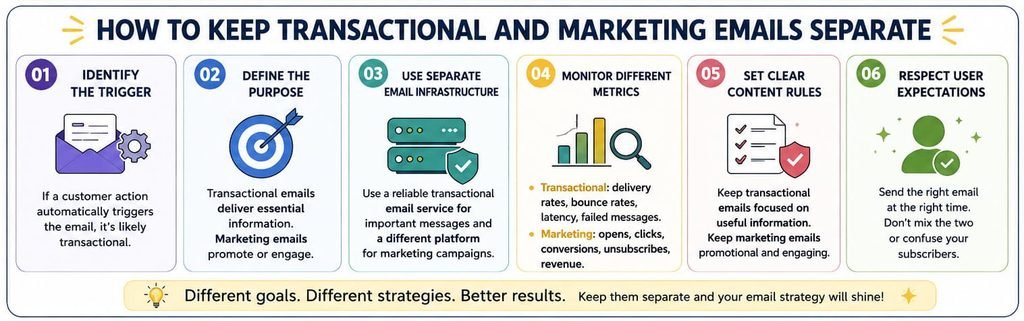
Keeping the two categories separate can make your email strategy cleaner and easier to manage.
Start by identifying what triggers each message.
If a customer action automatically triggers the message, you probably have a transactional email. If your marketing team chooses when and why to send it, you probably have a marketing email.
You should also monitor different metrics.
For transactional messages, focus on:
- Delivery rates
- Bounce rates
- Delivery latency
- Failed messages
- Clicks on essential links
- Authentication and sender reputation
For marketing campaigns, pay closer attention to:
- Open rates
- Click-through rates
- Conversion rates
- Unsubscribe rates
- Revenue per campaign
- Subscriber engagement
These metrics tell different stories, so combining everything into one giant dashboard can create more confusion than insight.
Final Thoughts
The difference between transactional email vs marketing email isn’t complicated once you focus on the purpose behind each message.
Transactional emails respond to customer actions and deliver important information. Marketing emails promote, educate, and engage subscribers.
Both matter, but they need different strategies.
If you’re building a SaaS product, ecommerce store, membership website, or online service, reliable transactional email can make a surprisingly big difference to the customer experience. A customer shouldn’t have to wonder whether their payment worked, where their verification email went, or why their password reset link never arrived.
So before you hit “send,” ask one simple question: Am I helping this customer complete an action, or am I trying to sell them something?
Once you answer that, choosing the right type of email becomes a whole lot easier.