
Top 10 AI Resume Builders in 2026: The Definitive Ranking and Reviews
Applying for jobs these days can feel like shouting into a void. It is exhausting. The problem isn’t that resumes are hard to write anymore; in fact, with generic AI chatbots, they are almost too easy.
Everyone is sending in perfectly polished but identical documents, which means recruiters are overwhelmed and relying entirely on software to filter people out.
If you aren’t optimized for their systems, you just don’t get seen.
The good news is that you still don’t have to do this completely manually. Dedicated AI resume builders can now take your raw experience and construct a professional, compliant resume for you in minutes, handling all the formatting and keyword matching that usually takes hours.
We looked for top AI resume builders that understand how hiring works right now. You need a tool that helps you get past the filters and in front of a real person.
We tested the best options out there to see which ones are worth your time.
How We Ranked the Best AI Resume Builders
To separate the genuinely helpful tools, put these platforms to work. Each builder was evaluated against four simple but critical criteria:
- The Robot Test (ATS Compliance). It doesn’t matter how beautiful a resume looks if the hiring software can’t read it. We prioritized tools that produce clean, parseable files that don’t get scrambled by Applicant Tracking Systems.
- The “Match” Quality. A generic resume rarely wins. We looked for tools that can analyze a specific job description and tell you which skills or keywords you need to add to increase your chances.
- Workflow Integration. The best AI resume builders do more than just generate a PDF. We gave higher marks to platforms that help you organize your search, track applications, or automate the tedious parts of applying.
- Ease of Use. You shouldn’t need a design degree to build a CV. If a tool was clunky, confusing, or frustrating to navigate, it lost points.
The Top 10 AI Resume Builders List Categorized for Scannability
Each platform evaluated below is chosen on its utility as a strategic partner in a job search.
1. CareerSwift: The All-in-One Powerhouse
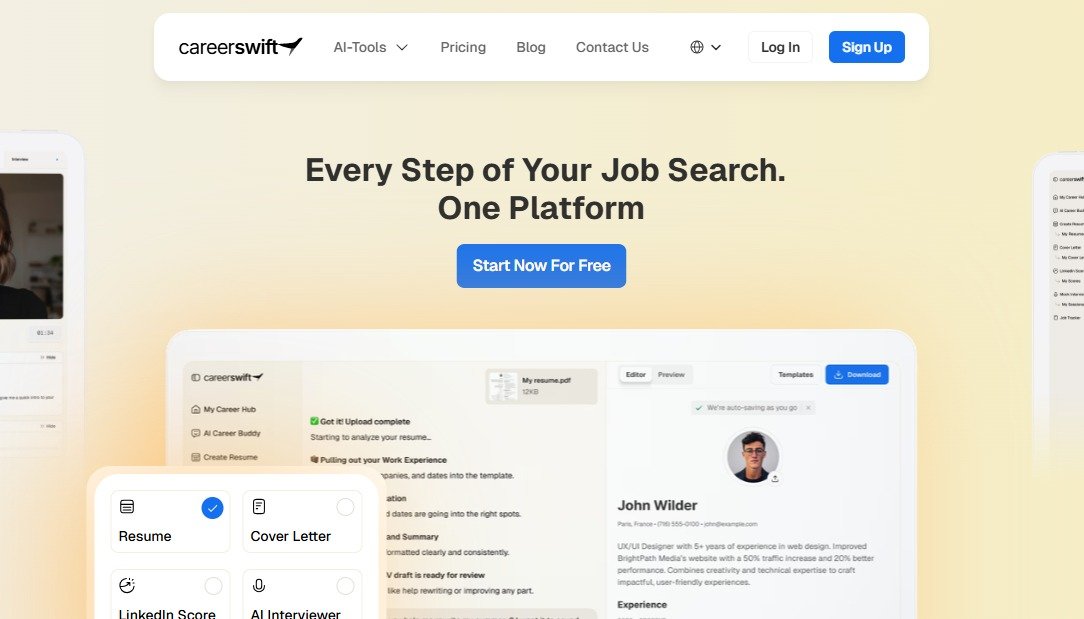
CareerSwift was chosen as the best AI resume builder, as it has effectively solved the “50-hour problem” (the administrative burden of manual applications).
Moreover, it operates less like a document editor and more like an executive assistant.
For senior leaders who value their time at a premium, this is the only platform that addresses the entire application lifecycle rather than just the artifact.
It moves beyond the limitations of standard GPT wrappers by integrating deep workflow automation, allowing candidates to manage the search process with the same rigor they would apply to a business operation.
The platform’s application engine leverages an autonomous agent that tailors the CV to specific job requirements in real-time as well as auto-populate complex portals.
This significantly reduces the friction between intent and submission. By actively managing the “apply” phase, CareerSwift ensures that the resume is delivered to the destination.
2. Teal: The Job Tracker’s Favorite
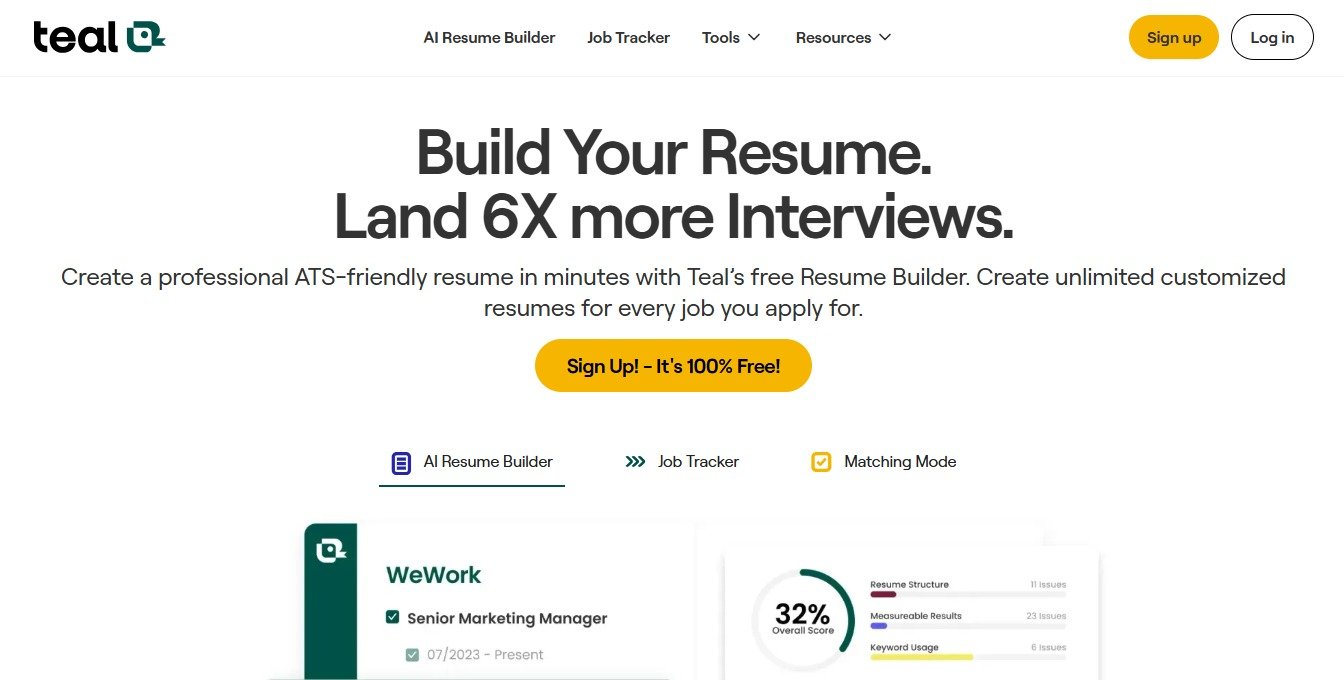
Teal remains the gold standard for candidates who require a centralized dashboard to manage a high volume of opportunities, effectively treating the job search with the discipline of a sales pipeline.
If a candidate views their job search as a funnel, this tool provides the necessary CRM infrastructure to track conversion rates from initial interest to final offer.
It excels at decluttering the chaotic process of modern job hunting, allowing users to bookmark jobs from across the web and manage them in a single, coherent interface.
Its Matching Mode provides a granular gap analysis by comparing the user’s profile against a target job description side-by-side.
This feature offers a clear, data-driven roadmap of the specific semantic keywords required to achieve a high match score.
3. Kickresume: The Visual Storyteller

For Creative Directors, CMOs, and Product Leaders, a text-only resume fails to convey brand aesthetic, yet highly designed PDFs are frequently rejected by parsing software.
Kickresume bridges this gap between high-design visual presentation and backend ATS parseability, proving that a dossier can be visually compelling without being algorithmically invisible.
It is the premier choice for professionals whose roles demand a demonstration of design thinking and visual communication.
As digital presence is scrutinized as heavily as the static CV, Kickresume’s AI Website Builder offers a significant competitive advantage.
It instantly converts the resume data into a dynamic, mobile-responsive personal portfolio site. This allows candidates to present a consistent brand across multiple touchpoints.
4. Rezi: The ATS Specialist

Rezi is the utilitarian choice for high-compliance sectors like Government, Finance, and Engineering, where formatting errors can lead to immediate disqualification.
It eschews aesthetic flourishes in favor of rigid technical perfection, making it the ideal tool if the primary obstacle is a strict initial algorithmic filter.
The platform is designed with a “safety-first” philosophy, prioritizing the machine-readability of the document above all else to ensure it survives the first round of automated culling.
The platform provides the highest probability of bypassing the gatekeeper through its Rezi Score, which serves as an industry-standard audit.
This feature rigorously tests the document against thousands of parsing rules to ensure zero data loss occurs during the transfer from PDF to database.
5. Jobscan: The Optimizer
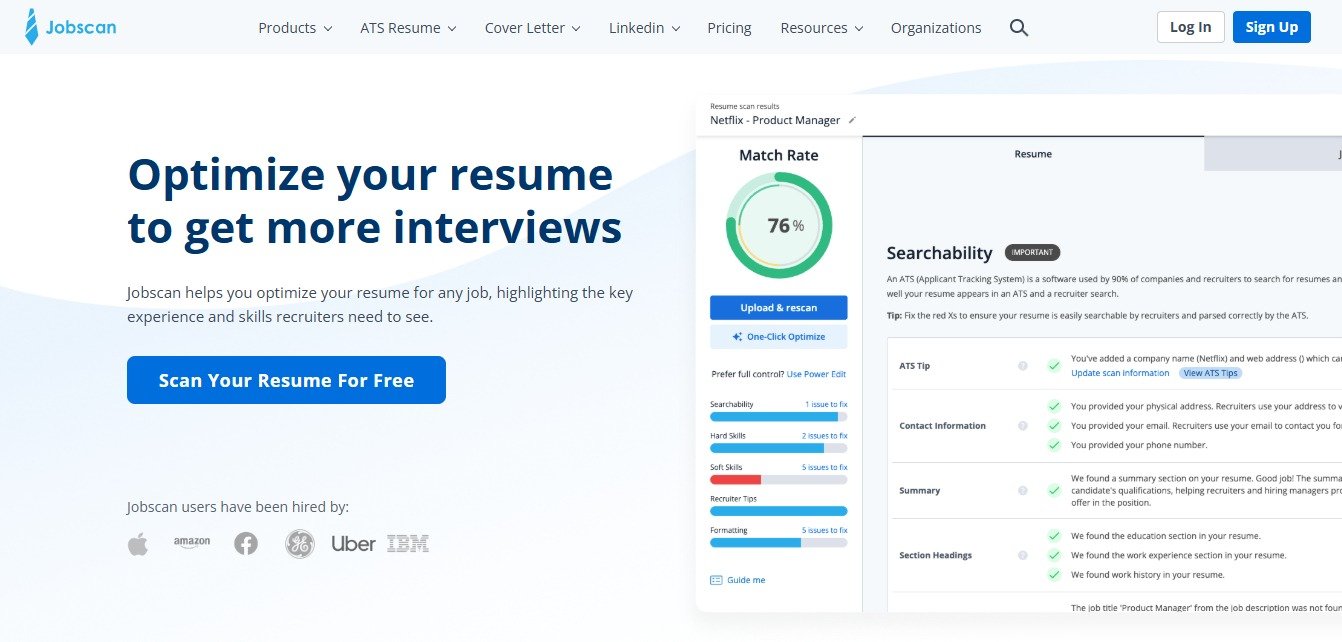
Jobscan is best utilized as an auditing tool since it acts as a final quality assurance check before market release.
The tool is indispensable for executives who possess a strong foundational resume but require specific alignment with a target role to maximize relevance.
Jobscan’s Power Edit feature operates like a relevance spell-checker. By overlaying the resume with the specific job description, it highlights skill gaps and keyword deficiencies in real-time.
This allows for precision targeting of the narrative, ensuring that the candidate’s experience is translated into the exact language the employer is using, thereby significantly increasing the “match rate” calculated by hiring algorithms.
6. Upplai: The Transparent Agent
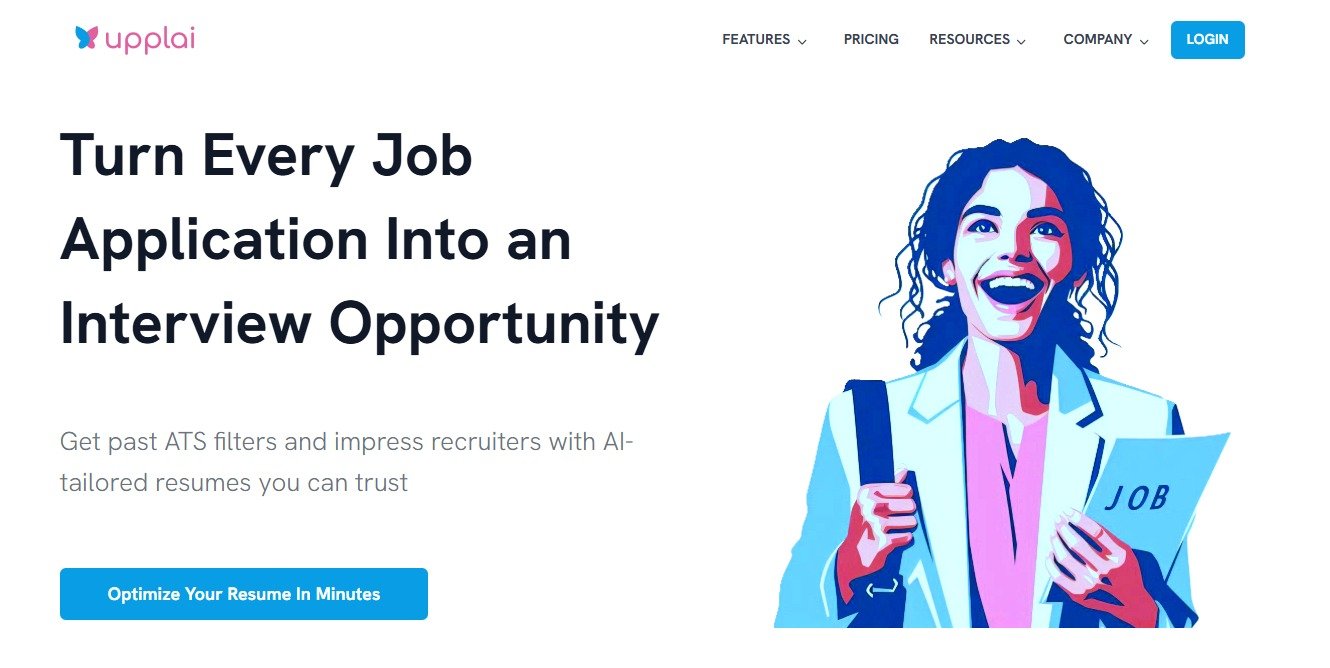
Trust is the primary friction point with AI adoption in the hiring space, and Upplai distinguishes itself by providing “Explainable AI.”
It does not simply alter the text; it provides the strategic rationale behind every edit, bridging the gap between automated efficiency and human executive control.
This approach appeals to professionals who are wary of “black box” algorithms and demand to understand the logic behind the changes being made to their career history.
Through its Transparency Engine, users see a differential view displaying the original text alongside the AI’s suggested optimization and, crucially, the strategic reasoning.
For example, it might explain that it shifted a bullet point to active voice to drive impact metrics or removed a cliché to improve professional tone.
7. Enhancv: The Modern Professional
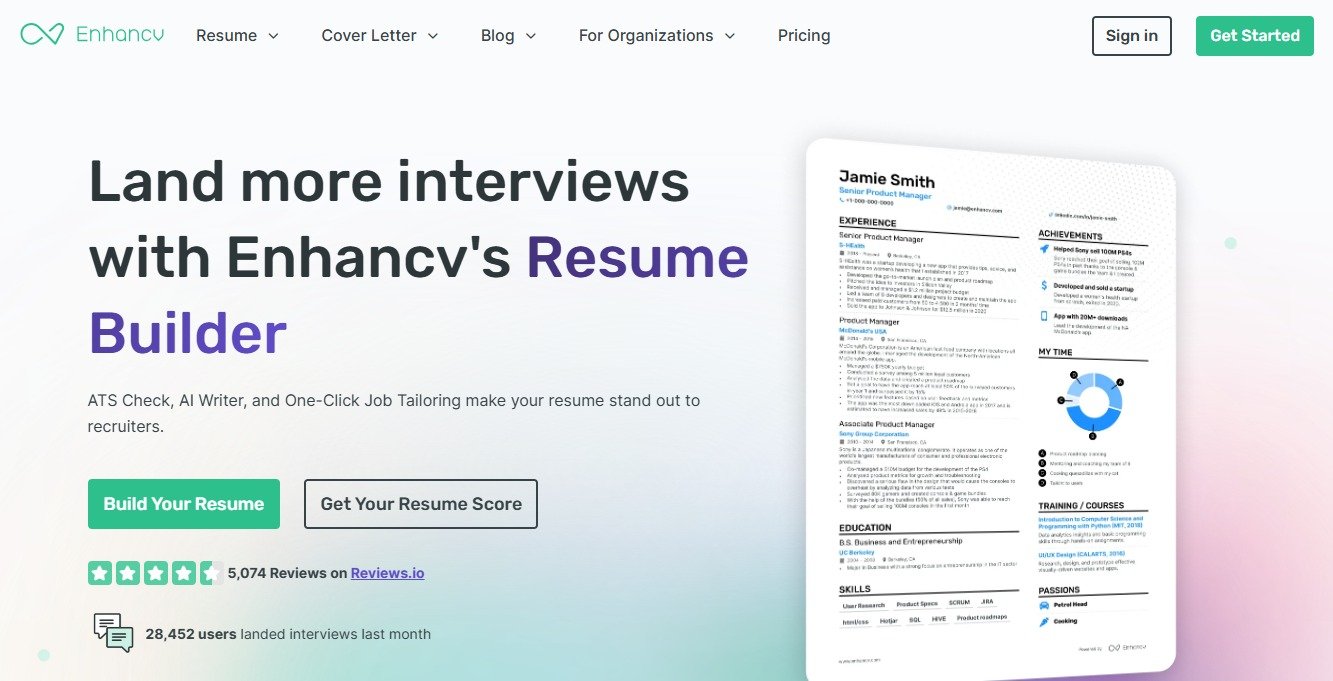
“Culture fit” is increasingly difficult to quantify on paper, yet it remains a top hiring priority. Enhancv’s architecture allows senior leaders to signal management philosophy and soft skills without compromising professional integrity.
It is particularly effective for roles in startups and modern technology firms where personality and values are weighed as heavily as technical competency.
The platform distinguishes itself with modular sections such as “My Time” (a visual breakdown of daily focus allocation) or “Books I Read.”
These features allow executives to subtly communicate their leadership style, intellectual curiosity, and cultural alignment.
8. Jasper: The Copywriting Heavyweights
While not a dedicated resume builder, this platform remains best-in-class for generating high-fidelity raw copy.
For complex rewrites, such as translating technical jargon into executive summaries or crafting compelling cover letters, its advanced language models often outperform the restricted templates of niche resume tools.
Jasper is best used as “content forge” for the initial drafting phase, where the goal is to produce rich, persuasive language.
Its command-based prompting allows for granular control over tone and syntax, enabling users to request a rewrite of a bullet point to “sound authoritative” or “include specific growth metrics.”
This produces copy that is significantly sharper and more varied than standard template-based output.
9. LinkedIn Resume Builder: The Networker
When speed is the priority over depth, LinkedIn’s native integration offers the path of least resistance.
It scrapes the user’s existing profile to generate a standardized PDF in seconds, making it an effective solution for rapid applications or immediate networking follow-ups.
For professionals who keep their LinkedIn profiles meticulously updated, this tool eliminates the redundancy of double-entry, turning the profile itself into the source of truth.
However, its convenience comes with limitations regarding customization and narrative control.
While it ensures the document is always reflective of the current public data, the output is often generic and lacks the tailored nuance required for C-Suite roles.
It is best deployed as a secondary tool for “easy apply” scenarios or initial conversations.
10. FlowCV: The Budget Friendly
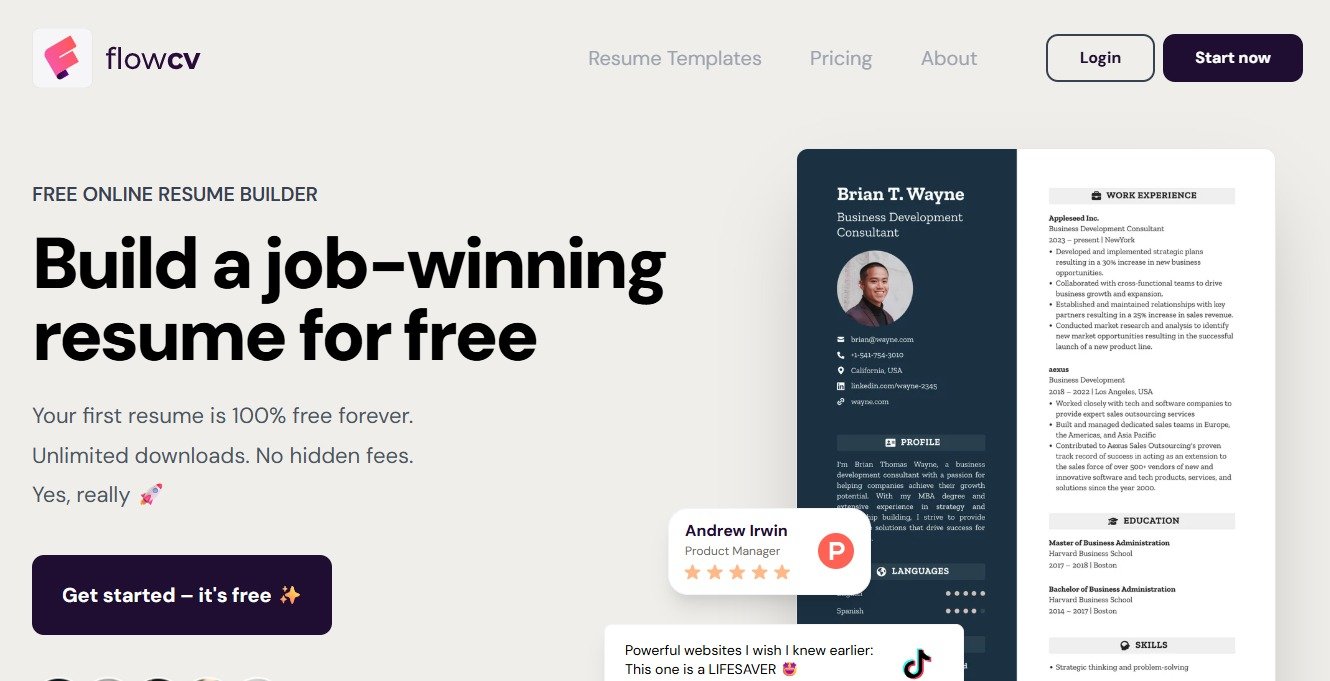
FlowCV demonstrates that zero-cost does not equate to low-value, offering a clean, distraction-free interface that produces professional, ATS-compliant documents.
It is the ideal entry point for early-career professionals, freelancers, or those testing the market.
The platform prioritizes user experience, removing the clutter and paywalls that plague many “freemium” competitors.
The “Free Forever” tier is robust, offering significant customization, intuitive column management, and watermark-free exports.
Unlike other free tools that hold the final file hostage, FlowCV provides genuine utility upfront.
It allows users to experiment with different layouts and designs effortlessly, making it a favorite for those who want full control over the visual structure of their resume without needing graphic design skills.
The Decision Matrix: Which Tool is Right for You?
Choosing a resume tool is about picking the right one for your situation. Here is a simple guide to help you decide.
You are busy and hate applying
You already have a job, but you want a better one. You don’t have time to spend your evenings filling out endless forms and rewriting your resume for every single application.
Choose CareerSwift. This tool acts like a personal assistant. Instead of just fixing your resume, it helps you apply.
It handles the boring stuff, like tailoring your CV to the job description and filling out those repetitive application forms, so you don’t have to. Use this if you want to save time.
You are applying to 50+ jobs
You are treating your job search like a numbers game. You have applied to so many places that you are losing track of who you emailed, which resume you sent, and who you need to follow up with.
Choose Teal. This is the best tool for organization. It works like a digital notebook that keeps everything in one place.
You can save jobs from different websites, track your progress, and see exactly what keywords you are missing. Use this if you feel overwhelmed by the mess.
You keep getting rejected instantly
You are applying to big companies, banks, or government roles. You feel like a human never actually sees your resume because you get a rejection email five minutes after applying.
Choose Rezi. You are likely failing the “robot test.” Rezi focuses purely on the technical side.
It doesn’t make your resume look fancy; it makes it readable for the software that big companies use. Use this if you just want to get past the initial filter.
You work in a creative field
You are a designer, marketer, or artist. You know your resume needs to pass the software test, but you also know that if it looks boring, a creative director will throw it in the trash.
Choose Kickresume. This tool finds the middle ground. It helps you create a resume that looks beautiful and professional but is still built in a way that computers can read. It even lets you turn your resume into a personal website with one click.
You have one specific dream job
You aren’t applying everywhere. You found the perfect job, and you have one shot to get it right. You already have a resume, but you want to be 100% sure it matches what they are looking for.
Choose Jobscan. Don’t start from scratch. Upload your resume and the job description, and Jobscan will act like a spell-checker for your skills.
It will tell you exactly which words you are missing so you can fix them before you hit send.
Final Thoughts
The goal of this analysis was to determine which platforms solve the structural problems of modern hiring. In 2026, the resume effectively transitioned from a static biography to a dynamic data packet.
The traditional method of manually tweaking a document for hours is no longer a viable strategy against the sophisticated AI agents and semantic filters that recruiters deploy.
Ultimately, the “best” tool is situational. Utilities like Rezi or Jobscan serve as surgical instruments for technical compliance, ensuring data survives the transfer to an ATS.
Meanwhile, broader platforms like Teal or CareerSwift function as workflow engines for those managing high-volume searches. The right choice depends entirely on where the friction lies in your specific career stage.
The technology is here to handle the noise. Your job is to provide the signal.