
How AI Search Chooses Which Brands to Recommend
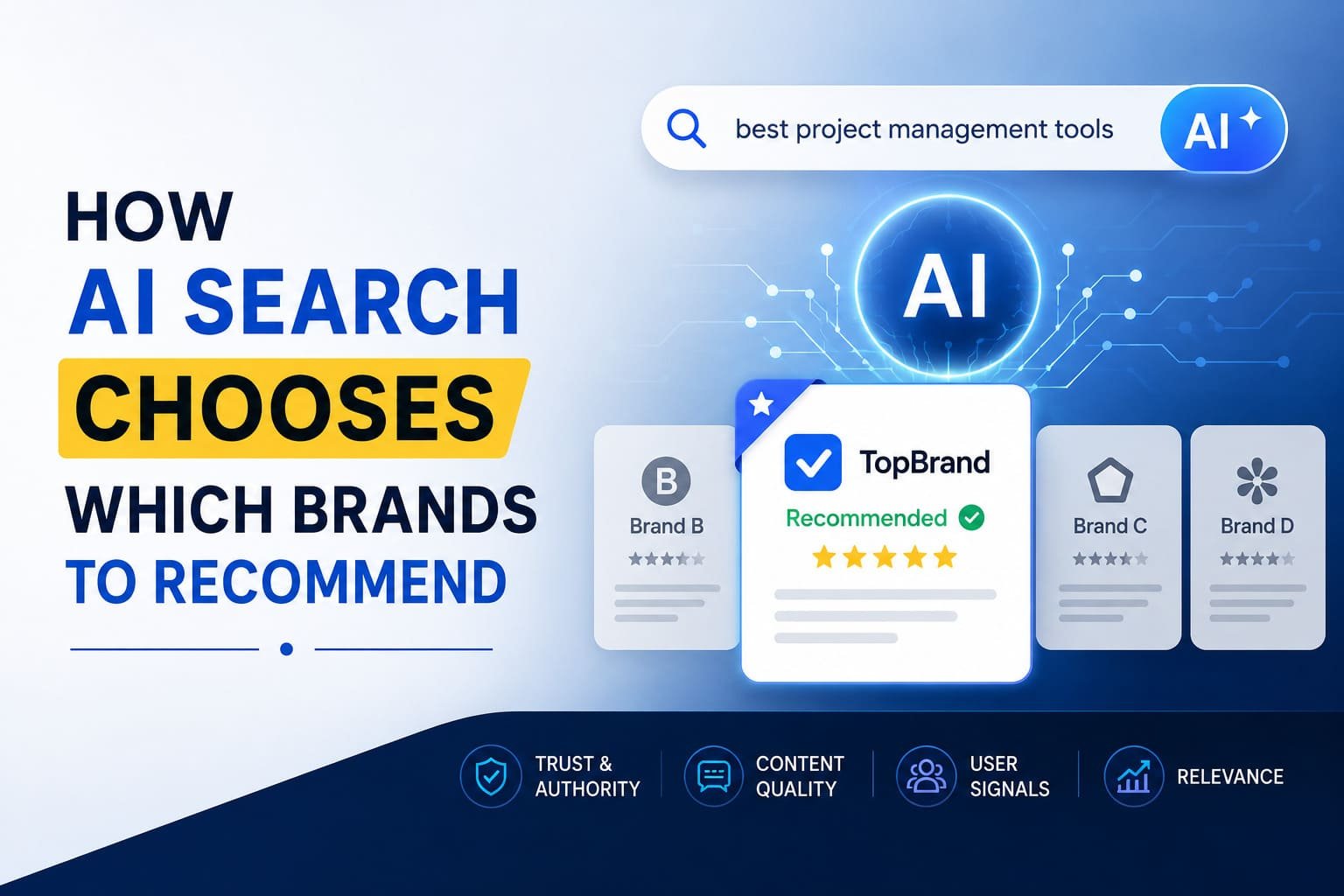
Let’s discuss how search worked a few years ago.
If someone searched for keywords such as “best SaaS tool,” “best agency,” or “best software company,” the job for an SEO team was fairly clear: get the brand’s website ranking for the right keywords.
But now, AI search has changed the question.
Now, you can ask ChatGPT, Gemini, Perplexity, Claude, or any other tool: “What are the best video production companies for SaaS brands?” Or “Which SEO tools are best for a small B2B company?”
This time, you aren’t looking for ten blue links. You want a direct answer or just the names of the best tools or companies.
And that creates a question for brands: why does one company get recommended while another doesn’t?
After working in SEO and tracking how brands appear across search and AI results, I’ve found that there isn’t one simple answer. There is also no publicly confirmed formula that tells us exactly how every AI platform selects brands.
But there are some patterns and steps to follow that can help you understand this.
Ranking for a keyword is no longer the whole story
A brand can rank well for its main keyword and still have very little visibility in AI-generated recommendations. Similarly I also see some time, companies that are visible in AI searches are not performing well organically.
I’ve seen this distinction become more obvious when checking the same query across traditional search and AI search.
For example, a company may rank on the first page for “SaaS video production company,” but when you ask an AI platform for the best SaaS video agencies, completely different companies can appear.
Why?
Because the AI isn’t simply asking: “Who ranks highest for this keyword?”
It is trying to match the user’s request with information it can find about different companies.
That means being visible for a keyword is useful, but it doesn’t automatically make a brand a recommendation.
AI needs to understand what your company actually does
This sounds basic, but many company websites make this harder than it should be.
I’ve worked on websites where the company has a strong product but the website uses vague language such as: “Helping businesses transform their digital future.”
That may sound good in a company presentation, but it doesn’t tell a search system much.
- What does the company sell?
- Who is it for?
- Which problem does it solve?
- Which industries does it serve?
- A much clearer description would be something like:
“An AI customer support platform for B2B SaaS companies that automates ticket routing and customer responses.”
Now there is context.
The same principle applies to service companies. If an agency wants to be recognized for SaaS explainer videos, that relationship should be clear across its website, case studies, service pages, author profiles, and external mentions.
Your website isn’t the only source of information
This is the most important point for marketers to understand in the current scenario.
A company controls its own website, but it doesn’t control everything that is written about it online.
AI systems can potentially find information through publications, review websites, directories, community discussions, comparison pages, and other sources, depending on the platform and query.
That means there is a difference between what you are writing about your business and what others are talking or writing about you.
Suppose a SaaS company says it is an enterprise analytics platform.
If ten independent websites also describe it as an enterprise analytics platform, that gives the brand a much clearer online identity.
But if one website calls it an analytics platform, another calls it a CRM, and another calls it a marketing automation tool, the picture becomes less consistent.
This is one reason brand mentions and third-party coverage matter.
Not because every mention will result in an AI recommendation, but because they add more information about the company outside its own website.
In a more practical and personal way, imagine you are saying you are a good and humble person, but others are saying you are not a good person, you have no ethics, you don’t know how to behave with others, and you never help anyone. Then what identity do you have in the minds of others? What personality do you have outside?
The same thing applies to brands.
Being mentioned doesn’t mean being recommended
This is another distinction I think SEOs should pay more attention to.
A brand can appear in an AI answer without actually being the recommended choice.
For example: “Popular tools include A, B, C, and D.”
That’s a list.
Now change the question: “Which tool would you recommend for a 50-person SaaS company that needs Salesforce integration and strong reporting?”
The requirements have changed.
The AI now needs to match the products against specific needs.
This is where a brand’s use cases become important.
If your website only says that you are a “leading SaaS platform,” there isn’t much information to connect you with a particular customer problem.
But if your content, case studies, product pages, reviews, and external coverage consistently associate your product with a specific audience and use case, there is much more context available.
This is where content strategy becomes important
I don’t think the answer is to publish hundreds of articles because you want to appear in AI search.
We’ve already seen what happens when companies produce large amounts of generic SEO content.
The internet doesn’t need another article called: “10 Benefits of Digital Marketing.”
What is more useful is content based on real questions customers ask.
For a SaaS video company, that could be:
- How much does a SaaS explainer video cost?
- Should a SaaS company create a demo video or explainer video?
- What should a product launch video include?
- How long should a SaaS product video be?
- What type of video works best for a complex SaaS product?
These topics do something more useful than simply targeting keywords.
They create associations between the company, its expertise, its audience, and specific problems.
That is useful for users, traditional search, and potentially AI search as well.
Original information can make a difference
There is another area I think brands should invest more in: publishing information that other websites don’t already have.
This could be:
- Original research
- Customer data
- Industry surveys
- Case studies
- Benchmarks
- First-party experiments
- Internal findings
For example, instead of publishing another generic article about SaaS video marketing, a video company could analyze 1,000+ SaaS videos and publish findings about video length, structure, CTA types, visual styles, or scene duration.
That gives the company something different.
More importantly, it gives other websites a reason to mention the company.
This creates a much more useful SEO outcome than publishing another 1,500-word article based on the same information already available online.
What I would Suggest you to measuring AI visibility differently
If you’re working on SEO today, I wouldn’t only track rankings for your primary keywords.
Create a list of questions that your actual customers might ask AI tools.
For example:
- Best [category] for SaaS companies
- Best [service] for startups
- [Product category] alternatives
- Companies that specialize in [specific service]
Then test those queries across different AI search platforms periodically and make a sheet to analyse these questions
- Whether your brand appears
- Which competitors appear
- How your brand is described
- Whether you’re being recommended or simply mentioned
- What is the structure of the content in different tools
This can reveal something traditional keyword tracking doesn’t.
You may discover that you’re ranking well but rarely being recommended.
Or you may find that your brand is being mentioned for topics you aren’t actively targeting.
Both are useful SEO insights.
AI search isn’t creating a completely new SEO rulebook
For a long time, I have been telling people on LinkedIn and in one-to-one conversations: there is no new big task to do. Just do the fundamentals correctly, the same things we have been doing to rank in organic search.
Brands don’t need a separate “AI SEO” trick or a list of tips.
The difference is that we’re no longer optimizing only for a page to rank. We’re also trying to make the brand itself understandable across the web. That is probably the biggest shift I’ve noticed.
Google rankings tell us where a page appears. AI recommendations add another question:
When someone asks for a solution, does the system understand why your brand belongs in the answer?
There isn’t a guaranteed formula for that yet.
But from an SEO perspective, the direction is clear: brands need to build visibility not only around keywords, but around entities, expertise, use cases, reputation, and real-world evidence. And that is something worth paying attention to before AI recommendations become as important to customers as traditional search results.
About The Author
Mayank Goyal is an SEO Manager at What a Story. He has 8+ years of experience in SEO and digital marketing. He works across technical SEO, content strategy, organic growth, and AI search visibility, helping SaaS and tech brands turn search into measurable business growth.